Gastropoda |
Neogastropoda |
Turbinellidae
Miljö: miljö / Klimatzon / djupintervall / distributionsområde
Ekologi
Revassocierade; djupintervall 0 - 81 m (Ref. 83934). Tropical; 26°N - 9°S, 92°W - 73°E
Western Atlantic.
Längd vid första mognad / Storlek / Vikt / Ålder
Könsmognad: Lm ? range ? - ? cm Max length : 36.0 cm NG hane/ej könsbestämd; (Ref. 83435); common length : 35.0 cm TL hane/ej könsbestämd; (Ref. 355)
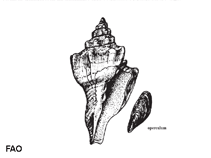
Shell very large, heavy, fusiform. Sculpture of 8 to 10 prominent ribs angled at shoulder, 8 to 10 on last whorl. Columella with 3 strong folds. Colour: white, internally tinged with pink or orange.
This is one of the largest gastropods in the Atlantic Ocean (Ref. 355). Maximum depth from Ref. 109264. This species is found subtidal and offshore, in coral reefs, cienaga facies and mangroves, particularly on mud, rock, sand, and seagrass habitats (Ref. 83934).
Livscykel och parningsbeteende
Könsmognad | Reproduktion | Lek | Ägg | Fekunditet | Larver
This species is a non-broadcast spawner. Life cycle does not include trocophore stage. Also Ref. 833.
Leal, J.H. 2003 Gastropods. p. 99-147. In Carpenter, K.E. (ed.). The living marine resources of the Western Central Atlantic. Volume 1: Introduction, molluscs, crustaceans, hagfishes, sharks, batoid fishes, and chimaeras. FAO Species Identification Guide for Fishery Purposes and American Society of Ichthyologists and Herpetologists Special Publication No. 5. 1600p. (Ref. 355)
Status på IUCN:s rödlista
(Ref. 130435: Version 2025-2 (Global))
CITES-status (Ref. 108899)
Not Evaluated
Not Evaluated
Hot mot människor
Harmless
Mänskliga användningsområden
Fiskeri: kommersiell
| FishSource |
Verktyg
Ytterligare information
PopulationsdynamikTillväxt
Max. åldrar / storlekar
Längd-vikt rel.
Längd-längd rel.
Längd-frekvenser
Massakonvertering
Abundans
LivscykelReproduktionKönsmognadFekunditetLekÄggUtveckling av äggLarver MänniskorelateradFrimärken, mynt, diverse.
Internet-källor
Uppskattningar baserade på modeller
Önskad temperatur
(Ref.
115969): 25.9 - 28.1, mean 27.5 (based on 160 cells).
Sårbarhet i fisket
Low to moderate vulnerability (26 of 100).
Priskategori
Unknown.