Gastropoda |
Littorinimorpha |
Strombidae
Milieu: milieu / Klimaatzone / Diepte / verspreidingsgebied
Ecologie
Benthic; diepte 2 - 73 m (Ref. 83934), usually ? - 30 m (Ref. 97646). Tropical; 33°N - 2°S, 97°W - 45°W
Western Atlantic: South Carolina to Brazil.
Lengte bij maturiteit / Grootte / Gewicht / Leeftijd
Maturiteit: Lm ?, range 2 - ? cm Max length : 30.0 cm SHL mannelijk / geslacht onbekend; (Ref. 105315); max. gepubliceerd gewicht: 3.3 kg (Ref. 105296); max. gerapporteerde leeftijd: 30 Jaren (Ref. 126618)
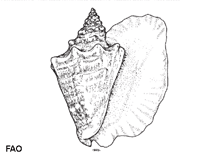
Shell large, with relatively large spire, flared outer lip with posterior expansion projecting well beyond spire length. Spire taller than other species in genus. Sculpture of sharp knobs along shoulder. Colour: pale tan with thin brown periostracum. Internal shell colour deep pink.
The fisheries have grown exponentially in the last 30 years, with resulting declines in population and area closures. The species has been included on appendix 2 of CITES (Convention on the International Trade of Endangered Species). International trade is allowed only from nations in which the populations of the species are not under threat from commercial fishing (Ref. 355). Maximum weight from Ref. 97674 cited in Ref. 105296. This species is found intertidal and offshore, on coral reefs, particularly on algae, coral sand, and seagrass habitats (Refs. 355, 83934). Adults prefer sandy algal flats; also found on gravel, coral rubble, smooth hard coral and beach rock bottoms. Rarely on soft bottoms of mud and/or silt. Benthic grazer. Feeds on diatoms, seagrass detritus, and various algae and epiphytes. Nocturnal (Refs. 105087, 127891) (Ref. 355).
Copulation may precede spawning. Spawning occurs on a type of calcareous sand formed from the fragmentation of coral reefs, including large quantities of calcareous skeletal remains from small molluscs and calcareous algae. Females deposit the egg mass on the substrate (Ref. 105320). Life cycle: Eggs hatch into veligers after 3-5 days which feed on phytoplankton; after 21 days they undergo metamorphosis (juvenile stage) where they remain buried in the sand and emerge in seagrass beds to feed; adults return to the shallow inshore waters to spawn.
Leal, J.H. 2003 Gastropods. p. 99-147. In Carpenter, K.E. (ed.). The living marine resources of the Western Central Atlantic. Volume 1: Introduction, molluscs, crustaceans, hagfishes, sharks, batoid fishes, and chimaeras. FAO Species Identification Guide for Fishery Purposes and American Society of Ichthyologists and Herpetologists Special Publication No. 5. 1600p. (Ref. 355)
Status op de Rode Lijst van het IUCN
(Ref. 130435: Version 2025-2 (Global))
CITES status (Ref. 108899)
Not Evaluated
Gevaar voor de mens
Gebruik door de mens
Visserij: van groot commercieel belang
| FIRMS (Stock assessments) | FishSource | Sea Around Us
Tools
Meer informatie
FysiologieZuurstofverbruik
Menselijk gerelateerdPostzegels, munten, diversen.
Internetbronnen
Schattingen op basis van modellen
Gewenste temperatuur
(Ref.
115969): 25.3 - 28, mean 27 (based on 146 cells).
Weerstandsvermogen
Gemiddeld, minimale populatieverdubbelingstijd 1,4-4,4 jaar (K=0.25-0.71; tm=3-4; tmax=30).
Prior r = 0.97, 95% CL = 0.64 - 1.45, Based on 4 data-limited stock assessments.
Kwetsbaarheid van de visserij
Moderate vulnerability (43 of 100).
Nutrients : Calcium = 126 [75, 177] mg/100g; Iron = 4.79 [1.67, 7.92] mg/100g; Protein = 15.9 [14.8, 16.9] %; Omega3 = 0.331 [0.263, 0.400] g/100g; Selenium = 57.8 [48.5, 67.2] μg/100g; VitaminA = 0 μg/100g; Zinc = 1.97 [0.92, 3.02] mg/100g (wet weight); based on
nutrient studies.