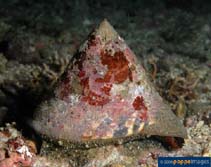
Gastropoda |
Trochida |
Tegulidae | Trochinae
Environment: milieu / climate zone / пределы глубины / distribution range
экология
; пределы глубины 0 - 20 m (ссылка 349). Tropical; 32°N - 25°S, 45°E - 171°E (ссылка 81851)
Indo-Pacific: from Madagascar, Sri Lanka, Andaman and Nicobar Islands, to as far east as French Polynesia, north to southern Japan and Hawaii, and south to Australia.
Length at first maturity / Size / Weight / Возраст
половая зрелость: Lm ? range ? - ? cm Max length : 15.0 cm SHH самец/пол неопределен; (ссылка 349); common length : 11.0 cm SHL самец/пол неопределен; (ссылка 349)
Shell conical, large, thick and very heavy. Body whorl almost smooth, with concave sides above a protuding, acutely rounded and thickened periphery. Base shell flat. Aperture squarish. Colouration: shell off-white, with large irregular axial reddish stripes (Ref. 128042).
It is the most economically important gastropod species in the tropical West Pacific. It is both an important traditional food and a leading export item used as a source of mother-of-pearl material for buttons and jewelry. Many small sized artisanal fisheries for meat and shell exist in other islands of the area. Due to severe and frequent overfishing, management policies are often adopted and aquaculture trials are under way (Ref. 349). Maximum depth from Ref. 799. Typically found in shallow, high energy portions of barrier and reefs (Refs. 349, 128042). Feeds on filamentous algae and generally avoids bottoms of sand and living corals. Population density generally decreasing in deeper areas, while the mean size of individuals increases (Ref. 349).
Life cycle and mating behavior
половая зрелость | размножение | нерест | Eggs | Fecundity | Larvae
Breeding period is marked by spring tides with external fertilization and nocturnal spawning.
Основная ссылка
ссылки | координатор | соавторы
Poutiers, J.M. 1998 Gastropods. p. 363-648. In Carpenter, K. E. and V. H. Niem. 1998. FAO species identification guide for fishery purposes. The living marine resources of the Western Central Pacific. Volume 1. Seaweeds, corals, bivalves, and gastropods. Rome, FAO. (ссылка 349)
Статус Красного Списка МСОП
(ссылка 130435: Version 2025-1)
Статус СИТЕС (ссылка 108899)
Not Evaluated
CMS (ссылка 116361)
Not Evaluated
Угроза для людей
Harmless
Использование человеком
рыболовство: коммерческий
FAO - рыболовство: landings | FishSource | Sea Around Us
инструменты
дополнительная информация
PhysiologyOxygen consumption
Human RelatedStamps, coins, misc.
ресурсы в Интернет
Estimates based on models
Preferred temperature
(Ref.
115969): 26.3 - 29.3, mean 28.7 (based on 2725 cells).
устойчивость к внешним воздействиям
средний (среднего размера), минимальное время удвоения популяции 1.4-4.4 года (K=0.19-0.36).
Fishing Vulnerability
Low to moderate vulnerability (33 of 100).
Категория цены
Unknown.
Nutrients : Calcium = 126 [75, 177] mg/100g; Iron = 4.79 [1.67, 7.92] mg/100g; Protein = 15.9 [14.8, 16.9] %; Omega3 = 0.331 [0.263, 0.400] g/100g; Selenium = 57.8 [48.5, 67.2] μg/100g; VitaminA = 0 μg/100g; Zinc = 1.97 [0.92, 3.02] mg/100g (wet weight); based on
nutrient studies.