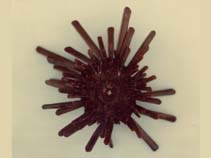
Echinoidea |
Camarodonta |
Echinometridae
Miljö: miljö / Klimatzon / djupintervall / distributionsområde
Ekologi
Revassocierade; djupintervall 0 - 30 m (Ref. 95661). Tropical
Indo-Pacific, except Arabian Gulf, Pakistan, West India and Bay of Bengal.
Längd vid första mognad / Storlek / Vikt / Ålder
Könsmognad: Lm ? range ? - ? cm
Occurs in shallow water reef areas at depths of 0 to 25 m (Ref. 800). Found on a reef crest (Ref. 97449). Favors depressions on the reef associated with pinnacles, corals or between rocks (Ref. 102370).
Livscykel och parningsbeteende
Könsmognad | Reproduktion | Lek | Ägg | Fekunditet | Larver
Members of the class Echinoidea are gonochoric. Fertilization is external. Brooding is common, eggs are held either on the peristome, around the periproct or deep into the concavities on the petaloids. Life cycle: Embryos develop into planktotrophic larvae (echinoplateus) and live for several months before they sink to the bottom using their tube feet to adhere on the ground where they metamorphose into young urchins.
Schoppe, S. 2000 A guide to common shallow water sea stars, brittle stars, sea urchins, sea cucumbers and feather stars (echinoderms) of the Philippines. Times Media Private Limited, Singapore. 144 p. (Ref. 800)
Status på IUCN:s rödlista
(Ref. 130435: Version 2025-2 (Global))
CITES-status (Ref. 108899)
Not Evaluated
Not Evaluated
Hot mot människor
Mänskliga användningsområden
| FishSource |
Verktyg
Ytterligare information
Trofisk ekologiLivsmedelsartiklar (preys)
Födosammansättning
Födointag
Predatorer
PopulationsdynamikTillväxt
Max. åldrar / storlekar
Längd-vikt rel.
Längd-längd rel.
Längd-frekvenser
Massakonvertering
Abundans
LivscykelReproduktionKönsmognadFekunditetLekÄggUtveckling av äggLarver MänniskorelateradFrimärken, mynt, diverse.
Internet-källor
Uppskattningar baserade på modeller
Önskad temperatur
(Ref.
115969): 24.6 - 29.3, mean 28 (based on 1903 cells).
Priskategori
Unknown.