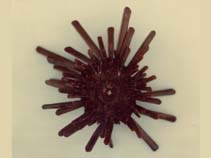
Echinoidea |
Camarodonta |
Echinometridae
Milieu: milieu / Klimaatzone / Diepte / verspreidingsgebied
Ecologie
Rifbewoner; diepte 0 - 30 m (Ref. 95661). Tropical
Indo-Pacific, except Arabian Gulf, Pakistan, West India and Bay of Bengal.
Lengte bij maturiteit / Grootte / Gewicht / Leeftijd
Maturiteit: Lm ? range ? - ? cm
Occurs in shallow water reef areas at depths of 0 to 25 m (Ref. 800). Found on a reef crest (Ref. 97449). Favors depressions on the reef associated with pinnacles, corals or between rocks (Ref. 102370).
Levenscyclus en paargedrag
Maturiteit | Voortplanting | Paaien | Eieren | Fecunditeit | Larven
Members of the class Echinoidea are gonochoric. Fertilization is external. Brooding is common, eggs are held either on the peristome, around the periproct or deep into the concavities on the petaloids. Life cycle: Embryos develop into planktotrophic larvae (echinoplateus) and live for several months before they sink to the bottom using their tube feet to adhere on the ground where they metamorphose into young urchins.
Schoppe, S. 2000 A guide to common shallow water sea stars, brittle stars, sea urchins, sea cucumbers and feather stars (echinoderms) of the Philippines. Times Media Private Limited, Singapore. 144 p. (Ref. 800)
Status op de Rode Lijst van het IUCN
(Ref. 130435: Version 2025-2 (Global))
CITES status (Ref. 108899)
Not Evaluated
Not Evaluated
Gevaar voor de mens
Gebruik door de mens
| FishSource |
Tools
Meer informatie
Trofische ecologieVoedsel (prooien)
Dieetsamenstelling
Voedselconsumptie
Predatoren
PopulatiedynamicaGroei
Max. leeftijden / maten
Lengte-gewicht rel.
Lengte-lengte rel.
Lengtefrequenties
Massaconversie
Abundantie
LevenscyclusVoortplantingMaturiteitFecunditeitPaaienEierenOntwikkeling van de eierenLarven FysiologieZuurstofverbruik
Menselijk gerelateerdPostzegels, munten, diversen.
Internetbronnen
Schattingen op basis van modellen
Gewenste temperatuur
(Ref.
115969): 24.6 - 29.3, mean 28 (based on 1903 cells).
Prijsklasse
Unknown.