Polyplacophora |
Chitonida |
Mopaliidae
Meio ambiente: milieu / Zona climática / intervalo de profundidade / faixa de distribuição
Ecologia
Benthic. Temperate
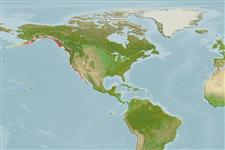
Eastern Pacific: Canada, Alaska to Mexico.
Comprimento de primeira maturação / Tamanho / Peso / Idade
Maturidade: Lm ? range ? - ? cm Max length : 5.1 cm TL macho/indeterminado; (Ref. 296)
Girdle: Wide with sparse flat glassy hairs having several recurved spines at the base. Mucro: Strongly posterior. Valves: Beaked slightly. Central areas: Longitudinally ribbed and where each rib touches the lateral area there is a granular pustule. Pustules: Form a heavy lateral rib; from this rib the central area rib continues at an oblique angle on the lateral areas until it again reaches a granular pustule at the posterior edge of the valve; pustules form another granular rib along the posterior edge of each valve. Color: Ranging from dull gray, grays with white, greens with yellows, whites with yellows, greens with red, greens with maroon with white mixed in (Ref. 296). Body: Oval to elongate (Ref. 290). Girdle: Medium wide nude; microscopically granulated fleshy. Mucro: Anterior. Central areas: Smooth. Lateral areas: Defined by a slightly raised rib with a smooth area inside. Color of valves: Blood red with white lightning marks. Color of girdle: Cream (Ref. 296).
Intertidal to shallow subtidal (Ref. 290).
Ciclo de vida ou comportamento de acasalamento
Maturidade | Reprodução | Desova | Ovos | Fecundidade | Larvas
Appears to have an annual reproductive cycle with spawning cued by spring phytoplankton (Ref. 290).
Burghardt, G. and L. Burghardt 2006 West Coast Chitons. A Gallery of Worlwide Chitons: http://home.inreach.com/burghart/wcoast.html[accessed20/01/06] (Ref. 296)
Status na Lista Vermelha da UICN
(Ref. 130435: Version 2025-2 (Global))
Status no CITES (Ref. 108899)
Not Evaluated
Not Evaluated
Ameaça para os humanos
Uso pelos humanos
| FishSource |
Ferramentas
Mais informação
Ecologia TróficaItens alimentares (presas)
Composição da dieta
Consumo alimentar
Predadores
Dinâmica populacionalCrescimento
Idade máxima / tamanhos
Relação comprimento-peso.
Relação comprimento-comprimento.
Frequências de comprimento
Conversão de massa
Abundância
Ciclo de vidaReproduçãoMaturidadeFecundidadeDesovaOvosDesenvolvimento dos ovosLarvas FisiologiaConsumo de oxigênio
Relacionado a humanosSelos, moedas, diversos.
Fontes da internet
Estimativas baseadas em modelos
Temperatura preferida
(Ref.
115969): 6.1 - 14, mean 8.8 (based on 364 cells).
Vulnerabilidade da pesca
Low vulnerability (10 of 100).
Categoria de preço
Unknown.