Polyplacophora |
Chitonida |
Mopaliidae
Ambiente: milieu / zona climatica / distribuzione batimetrica / gamma di distribuzione
Ecologia
Benthic. Temperate
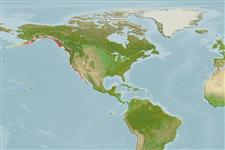
Eastern Pacific: Canada, Alaska to Mexico.
Lunghezza alla prima maturità / Dimensione / Peso / Età
Maturità: Lm ? range ? - ? cm Max length : 5.1 cm TL maschio/sesso non determinato; (Fonte Biblio. 296)
Girdle: Wide with sparse flat glassy hairs having several recurved spines at the base. Mucro: Strongly posterior. Valves: Beaked slightly. Central areas: Longitudinally ribbed and where each rib touches the lateral area there is a granular pustule. Pustules: Form a heavy lateral rib; from this rib the central area rib continues at an oblique angle on the lateral areas until it again reaches a granular pustule at the posterior edge of the valve; pustules form another granular rib along the posterior edge of each valve. Color: Ranging from dull gray, grays with white, greens with yellows, whites with yellows, greens with red, greens with maroon with white mixed in (Ref. 296). Body: Oval to elongate (Ref. 290). Girdle: Medium wide nude; microscopically granulated fleshy. Mucro: Anterior. Central areas: Smooth. Lateral areas: Defined by a slightly raised rib with a smooth area inside. Color of valves: Blood red with white lightning marks. Color of girdle: Cream (Ref. 296).
Intertidal to shallow subtidal (Ref. 290).
Ciclo vitale e comportamento di accoppiamento
Maturità | Riproduzione | Deposizione | Uova | Fecondità | Larve
Appears to have an annual reproductive cycle with spawning cued by spring phytoplankton (Ref. 290).
Burghardt, G. and L. Burghardt 2006 West Coast Chitons. A Gallery of Worlwide Chitons: http://home.inreach.com/burghart/wcoast.html[accessed20/01/06] (Fonte Biblio. 296)
Stato della Lista Rossa IUCN
(Fonte Biblio. 130435: Version 2025-2 (Global))
Stato della CITES (Fonte Biblio. 108899)
Not Evaluated
CMS (Fonte Biblio. 116361)
Not Evaluated
Minaccia per l'uomo
Usi umani
| FishSource |
Strumenti
Informazioni ulteriori
Ecologia troficaArticoli alimentari (prede)
Alimentazione
Consumo di cibo
Predatori
Dinamica della popolazioneAccrescimento
Età massima / dimensioni massime
Rapporto lunghezza-peso.
Lunghezza-lunghezza rel.
Lunghezza-frequenze
Conversione di massa
Abbondanza
Ciclo di vitaRiproduzioneMaturitàFeconditàDeposizioneUovaSviluppo delle uovaLarve FisiologiaConsumo di ossigeno
Legato all'uomoFrancobolli, monete, materiale vario.
Fonti Internet
Stime basate su modelli
Temperatura preferita
(Ref.
115969): 6.1 - 14, mean 8.8 (based on 364 cells).
Vulnerabilità della pesca
Low vulnerability (10 of 100).
Categoria di prezzo
Unknown.