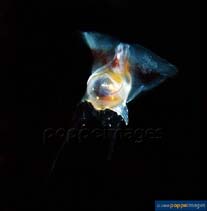
Gastropoda |
Pteropoda |
Cavoliniidae
Environnement : milieu / zone climatique / profondeur / gamme de distribution
Écologie
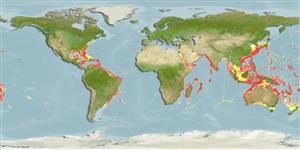
Pélagique; profondeur 0 - 1234 m (Réf. 83435). Subtropical
Indo-Pacific and Atlantic Ocean.
Longueur à la première maturité / Taille / Poids / Âge
Maturité: Lm ? range ? - ? cm Max length : 0.7 cm DL mâle / non sexé; (Réf. 83435)
Epipelagic (Ref. 108717). Dead shells frequently washed up on the beaches (Ref. 88739). Members of the family Cavoliniidae use mucus feeding to collect particles from surrounding waters (Ref. 108718). Feeds on plants (Ref. 108717). Suspension feeder (Ref. 109264).
Cycle de vie et comportement reproducteur
Maturité | Reproduction | Frai | Œufs | Fécondité | Larves
Members of the order Thecosomata are mostly simultaneous hermaphrodites.
Rottman, M. 1978 Ecology of recurrent groups of pteropods, euphausiids, and chaetognaths in the Gulf og Thailand and the South China Sea. Mar. Biol. 48:63-78. (Réf. 3702)
Statut dans la liste rouge de l'IUCN
(Réf. 130435: Version 2025-2 (Global))
statut CITES (Réf. 108899)
Not Evaluated
Not Evaluated
Menace pour l'homme
Utilisations par l'homme
| FishSource |
Outils
Plus d'informations
Dynamique des populationsCroissance
Âges / tailles maximales
Longueur-poids rel.
Rel. longueur-longueur.
Fréquences de longueurs
Conversion de masse
Abondance
Cycle de vieReproductionMaturitéFéconditéFraiŒufsDéveloppement de l'œufLarves PhysiologieConsommation d'oxygène
Liées à l'hommeTimbres, pièces de monnaie, divers
Sources Internet
Estimations basées sur des modèles
Température préférée
(Ref.
115969): 8.1 - 20.3, mean 12.4 (based on 864 cells).
Vulnérabilité de la pêche
Low vulnerability (10 of 100).
Catégorie de prix
Unknown.