Ascidiacea |
Phlebobranchia |
Corellidae
Environment: milieu / climate zone / depth range / distribution range
Ecology
Sessile; depth range 0 - 1376 m (Ref. 1662). Subtropical
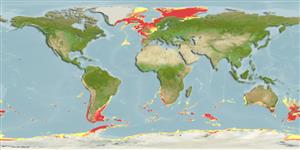
Atlantic Ocean, Indo-Pacific, Antarctic and the Mediterranean. Tropical to polar.
Length at first maturity / Size / Weight / Age
Maturity: Lm ? range ? - ? cm Max length : 24.0 cm TL male/unsexed; (Ref. 1753)
Minimum depth from Ref. 3435. Lives on hard (Ref. 1744) and soft substrate (Ref. 1753), like rock, sand, mud, under rocks, and is epibiotic on other ascidians, macroalgae, or mussels (Ref. 87801) on port or harbour structures like pilings or hulls of ships (Ref. 87801, 1134), at depths of 20 to 30 m, and on moraine deposits (Ref. 1753).
Life cycle and mating behavior
Maturity | Reproduction | Spawning | Eggs | Fecundity | Larvae
Members of the class Ascidiacea are hermaphroditic; both cross- and self-fertilization is typical. Life cycle: Eggs develop into lecithotrophic larva before metamorphosing into benthic adults.
Sanamyan, K.E. and N.P. Sanamyan 1999 Some benthic Tunicata from the southern Indo-Pacific Ocean. Journal of Natural History 33:1835-1876. (Ref. 1662)
IUCN Red List Status
(Ref. 130435: Version 2025-1)
CITES status (Ref. 108899)
Not Evaluated
Not Evaluated
Threat to humans
Human uses
| FishSource |
Tools
More information
Trophic EcologyFood items (preys)
Diet composition
Food consumption
Predators
Population dynamicsGrowth
Max. ages / sizes
Length-weight rel.
Length-length rel.
Length-frequencies
Mass conversion
Abundance
Life cycleReproductionMaturityFecunditySpawningEggsEgg developmentLarvae PhysiologyOxygen consumption
Human RelatedStamps, coins, misc.
Internet sources
Estimates based on models
Preferred temperature
(Ref.
115969): 0.2 - 9.6, mean 2.4 (based on 1969 cells).
Fishing Vulnerability
Low vulnerability (14 of 100).
Price category
Unknown.