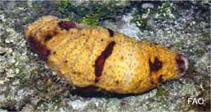
Holothuroidea |
Holothuriida |
Holothuriidae
สิ่งแวดล้อม : สิ่งแวดล้อม / เขตภูมิอากาศ / ระดับความลึก / ระยะการกระจายสินค้า
นิเวศวิทยา
Benthic; ระดับความลึก 0 - 54 m (อ้างอิง 83942). Tropical
Western Atlantic: Gulf of Mexico and the Caribbean.
ความยาวเมื่อครบกำหนดครั้งแรก / ขนาด / น้ำหนัก / อายุ
วัยเจริญพันธุ์: Lm ? range ? - ? cm Max length : 35.0 cm TL เพศผู้/กระเทย; (อ้างอิง 624)
A coastal and nocturnal species. Forages on algal turf, seagrass meadows, and in rubble or sand covered areas (Ref. 485). This is an epibenthic, subtidal species found in coral reefs, seagrass and rocky bottoms (Ref. 83942). Nocturnal. Forages on algal turf, seagrass meadows, and in rubble or sand covered areas (Ref. 485).
วงจรชีวิตและพฤติกรรมการผสมพันธุ์
วัยเจริญพันธุ์ | การสืบพันธุ์ | การวางไข่ | เซลสืบพันธ์ของเพศเมีย(ไข่) | ความดกของไข่ | ตัวอ่อน
Members of the class Holothuroidea are gonochoric and have only one gonad. Spawning and fertilization are both external and some exhibit brooding. Life cycle: Embryos develop into planktotrophic larvae (auricularia) then into doliolaria (barrel-shaped stage) which later metamorphose into juvenile sea cucumbers.
Hasbún, C.R. and A.J. Lawrence 2002 An annotated description of shallow water holothurians (Echinodermata: Holothuroidea) from Cayos Cochinos, Honduras. Revista de Biología Tropical 50(2):669-678. (อ้างอิง 624)
สถานะบัญชีแดงของ IUCN
(อ้างอิง 130435: Version 2025-2 (Global))
สถานะไซเตส (อ้างอิง 108899)
Not Evaluated
CMS (อ้างอิง 116361)
Not Evaluated
ภัยคุกคามต่อมนุษย์
การใช้ของมนุษย์
| FishSource |
เครื่องมือ
ข้อมูลเพิ่มเติม
นิเวศวิทยาเขตร้อนรายการอาหาร (เหยื่อ)
องค์ประอบของอาหาร
การบริโภคอาหาร
ผู้ล่า
พลวัตของประชากรการเจริญเติบโตอายุสูงสุด / ขนาดความยาว-น้ำหนักสัมพันธ์ความยาว-ความยาวสัมพันธ์ความยาว-ความถี่การแปลงมวลอุดมสมบรูณ์ วงจรชีวิตการสืบพันธุ์วัยเจริญพันธุ์ความดกของไข่การวางไข่เซลสืบพันธ์ของเพศเมีย(ไข่)การพัฒนาไข่ตัวอ่อน เกี่ยวข้องกับมนุษย์แสตมป์ เหรียญ อื่นๆ
แหล่งที่มาจากอินเตอร์เน็ต
การประมาณค่าตามแบบจำลอง
อุณหภูมิที่ต้องการ
(Ref.
115969): 24.9 - 28, mean 27 (based on 206 cells).
ความเสี่ยงต่อการตกปลา
Low vulnerability (25 of 100).
หมวดหมู่ราคา
Unknown.