Hexacorallia |
Actiniaria |
Hormathiidae
Milieu: milieu / Klimaatzone / Diepte / verspreidingsgebied
Ecologie
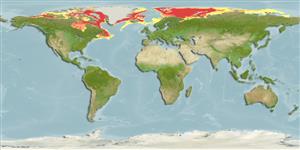
Sessile; diepte 6 - 1448 m (Ref. 78738). Polar; 82°N - 35°N, 145°W - 167°E
Arctic and Northern Atlantic: from Camden Bay, south to Cape Hatteras, North Carolina, north to Svalbard and east to Siberian waters. Temperate to polar.
Lengte bij maturiteit / Grootte / Gewicht / Leeftijd
Maturiteit: Lm ? range ? - ? cm
Solitary (Ref. 2377). Abundant in sublittoral banks and shallow seas (Ref. 119529).
Levenscyclus en paargedrag
Maturiteit | Voortplanting | Paaien | Eieren | Fecunditeit | Larven
Members of the class Anthozoa are either gonochoric or hermaphroditic. Mature gametes are shed into the coelenteron and spawned through the mouth. Life cycle: The zygote develops into a planktonic planula larva. Metamorphosis begins with early morphogenesis of tentacles, septa and pharynx before larval settlement on the aboral end.
Piepenburg, D., N.V. Chernova, C.F. von Dorrien, J. Gutt, A.V. Neyelov, E. Rachor, L. Saldanha and M.K. Schmid 1996 Megabenthic communities in the waters around Svalbard. Polar Biol. 16:431-446. (Ref. 2952)
Status op de Rode Lijst van het IUCN
(Ref. 130435: Version 2025-2 (Global))
CITES status (Ref. 108899)
Not Evaluated
Not Evaluated
Gevaar voor de mens
Gebruik door de mens
| FishSource |
Tools
Meer informatie
Trofische ecologieVoedsel (prooien)
Dieetsamenstelling
Voedselconsumptie
Predatoren
PopulatiedynamicaGroei
Max. leeftijden / maten
Lengte-gewicht rel.
Lengte-lengte rel.
Lengtefrequenties
Massaconversie
Abundantie
LevenscyclusVoortplantingMaturiteitFecunditeitPaaienEierenOntwikkeling van de eierenLarven FysiologieZuurstofverbruik
Menselijk gerelateerdPostzegels, munten, diversen.
Internetbronnen
Schattingen op basis van modellen
Prijsklasse
Unknown.