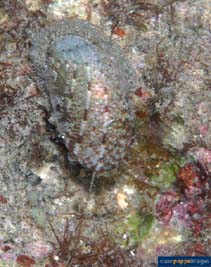
Gastropoda |
Trochida |
Trochidae
Environnement : milieu / zone climatique / profondeur / gamme de distribution
Écologie
Benthic; profondeur 0 - 67 m (Réf. 100540). Tropical
Indo-Pacific.
Longueur à la première maturité / Taille / Poids / Âge
Maturité: Lm ? range ? - ? cm
Minimum depth assumed from its ecology. Found in intertidal under rocks (Ref. 75835). Several individuals typically reside under the same rock (Ref. 101251). Members of the family Trochidae browse on detritus and algae, sometimes filter-feeding (Ref. 349).
Cycle de vie et comportement reproducteur
Maturité | Reproduction | Frai | Œufs | Fécondité | Larves
Members of the order Archaeogastropoda are mostly gonochoric and broadcast spawners. Life cycle: Embryos develop into planktonic trocophore larvae and later into juvenile veligers before becoming fully grown adults.
Allen, G.R. and S.A. McKenna 2001 A marine Rapid Assessment of the Togean and Banggai Islands, Sulawesi, Indonesia. RAP Bulletin of Biological Assessment 20, Conservation International, Washington, DC. (Réf. 75725)
Statut dans la liste rouge de l'IUCN
(Réf. 130435: Version 2025-2 (Global))
statut CITES (Réf. 108899)
Not Evaluated
Not Evaluated
Menace pour l'homme
Harmless
Utilisations par l'homme
| FishSource |
Outils
Plus d'informations
Écologie trophiqueAliments (proies)
Composition du régime alimentaire
Consommation alimentaire
Prédateurs
Dynamique des populationsCroissance
Âges / tailles maximales
Longueur-poids rel.
Rel. longueur-longueur.
Fréquences de longueurs
Conversion de masse
Abondance
Cycle de vieReproductionMaturitéFéconditéFraiŒufsDéveloppement de l'œufLarves PhysiologieConsommation d'oxygène
Liées à l'hommeTimbres, pièces de monnaie, divers
Sources Internet
Estimations basées sur des modèles
Température préférée
(Ref.
115969): 24.5 - 28.5, mean 27 (based on 452 cells).