Ascidiacea |
Stolidobranchia |
Styelidae
Environment: milieu / climate zone / depth range / distribution range
Ecology
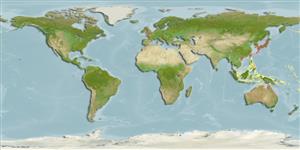
Sessile; depth range 0 - 8 m (Ref. 137670). Subtropical; 51°N - 22°N, 113°E - 156°E
Northwest Pacific: from Kuril Islands, South Korea and Japan, south to Hong Kong. Introduced in the Eastern Pacific, Atlantic and the Mediterranean.
Length at first maturity / Size / Weight / Age
Maturity: Lm ? range ? - ? cm
Filter-feeder (Ref. 68823). Part of fouling communities attached to raft frames in mariculture zones (Ref. 127121).
Life cycle and mating behavior
Maturity | Reproduction | Spawning | Eggs | Fecundity | Larvae
Members of the class Ascidiacea are hermaphroditic; both cross- and self-fertilization is typical. Life cycle: Eggs develop into lecithotrophic larva before metamorphosing into benthic adults.
Lambert, G. and K. Sanamyan 2001 Distaplia alaskensis sp.nov. (Ascidiacea, Aplousobranchia) and other new ascidian records from south-central Alaska, with a redescription of Ascidia columbiana (Huntsman, 1912). Can. J. Zool. 79:1766-1781. (Ref. 1745)
IUCN Red List Status
(Ref. 130435: Version 2025-2 (Global))
CITES status (Ref. 108899)
Not Evaluated
Not Evaluated
Threat to humans
Harmless
Human uses
| FishSource |
Tools
More information
Trophic EcologyFood items (preys)Diet compositionFood consumptionPredators Life cycleReproductionMaturityFecunditySpawningEggsEgg developmentLarvae PhysiologyOxygen consumption
Human RelatedStamps, coins, misc.
Internet sources
Estimates based on models
Preferred temperature
(Ref.
115969): 12.3 - 29.3, mean 28.4 (based on 2028 cells).
Price category
Unknown.