Aves |
Charadriiformes |
Alcidae
Environnement : milieu / zone climatique / profondeur / gamme de distribution
Écologie
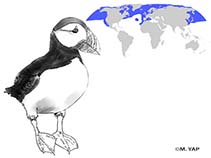
Others; profondeur 0 - 60 m (Réf. 62202), usually 20 - 30 m (Réf. 62202). Polar; 83°N - 24°N, 85°W - 71°E (Réf. 124582)
Arctic, Northern Atlantic and the Mediterranean. Boreal to polar.
Longueur à la première maturité / Taille / Poids / Âge
Maturité: Lm ? range ? - ? cm Max length : 30.0 cm TL mâle / non sexé; (Réf. 8812); poids max. publié: 381.00 g (Réf. 356)
Description synthétique
Morphologie
Culmen: 4.56 cm; tarsus: 2.88 cm; wing: 17.21 cm.
Total Length: 28 to 30 cm; Wingspan: 53 to 58 cm (Ref. 8812). Occupy the continental shelf; <100 km; exhibits plunge-diving feeding behavior (Ref. 356). In the North Sea off the east coast of Scotland and northern England, this species is known to feed on the sandeel, Ammodytes marinus and breeding birds spend approx. 80% of daylight period at sea, commonly in dense rafts. They form nesting colonies with breeding pairs sharing incubation and chick-rearing duties; surface-feeding by scooping prey from the water, they carry prey in their bills and feed their chicks with regurgitated food (Ref. 95711).
Cycle de vie et comportement reproducteur
Maturité | Reproduction | Frai | Œufs | Fécondité | Larves
Barrett, R.T. and F. Rikardsen 1992 Chick growth, fledging periods and adult mass loss of Atlantic Puffins Fratercula arctica during years of prolonged food stress. Colonial Waterbirds 15(1):24-32. (Réf. 4091)
Statut dans la liste rouge de l'IUCN
(Réf. 130435: Version 2025-2 (Global))
statut CITES (Réf. 108899)
Not Evaluated
Not Evaluated
Menace pour l'homme
Utilisations par l'homme
| FishSource |
Outils
Plus d'informations
Dynamique des populationsCroissanceÂges / tailles maximalesLongueur-poids rel.Rel. longueur-longueur.Fréquences de longueursConversion de masseAbondance Cycle de vieReproduction
Maturité
Fécondité
Frai
Œufs
Développement de l'œuf
Larves
PhysiologieConsommation d'oxygène
Liées à l'hommeTimbres, pièces de monnaie, divers
Sources Internet
Estimations basées sur des modèles
Température préférée
(Ref.
115969): 0.5 - 11.8, mean 6.8 (based on 976 cells).
Résilience
Haut, temps minimum de doublement de population inférieur à 15 mois (K=8.27-39.05).
Vulnérabilité de la pêche
Low vulnerability (20 of 100).
Catégorie de prix
Unknown.