Pycnogonida |
Pantopoda |
Ammotheidae
Environnement : milieu / zone climatique / profondeur / gamme de distribution
Écologie
Benthic; profondeur 0 - 50 m (Réf. 9). Temperate
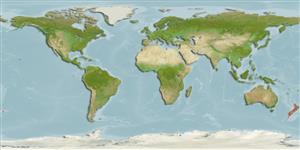
Southwest Pacific: New Zealand and Sub Antarctic Islands.
Longueur à la première maturité / Taille / Poids / Âge
Maturité: Lm ? range ? - ? cm
Description synthétique
Morphologie
Trunk: circular in dorsal outline, segmentation lines lacking first or second segments divided by line. Trunk and appendage spines with bifurcate tips, some trifurcate. Lateral processes: smooth, with small setae, touching for their lengths. Ocular tubercle: short, eyes prominent. Palp: distal 3 segments carried anaxially on extended 5th segment. Oviger strigilis: with setae but with small denticulate spines. Coxa: 2 distally swollen in females, with ventrodistal spur in males. Major leg: segments with longer than dorsal and lateral spines and few short setae. Tarsus: typical, very short, well curved, with 4, 5, or 6 larger heel spines, 8-10 small sole spines, claw and auxiliaries typical, robust (Ref. 9).
New Zealand and Sub Antarctic Islands, from 0 to 50 m. The Mahai Peninsula, shallow waters of South Island and its offshore island; endemic (Ref. 9).
Cycle de vie et comportement reproducteur
Maturité | Reproduction | Frai | Œufs | Fécondité | Larves
Members of the class Pycnogonida are gonochoric and sexually dimorphic. During copulation, male usually suspends itself beneath the female. Fertilization occurs as the eggs leave the female's ovigers. Males brood the egg masses until they hatch. Life cycle: Eggs hatch into protonymphon larva then to adults.
Child, C.A. 1998 The marine fauna of New Zealand: Pycnogonida (sea spiders). NIWA Biodiversity Memoire 109. National Institute of Water and Atmospheric Research (NIWA). Washington, D.C. 20530, USA. 71 p. + Figure 2A-G, 3A-F, 4, 5. (Réf. 9)
Statut dans la liste rouge de l'IUCN
(Réf. 130435: Version 2025-2 (Global))
statut CITES (Réf. 108899)
Not Evaluated
Not Evaluated
Menace pour l'homme
Utilisations par l'homme
| FishSource |
Outils
Plus d'informations
Écologie trophiqueAliments (proies)
Composition du régime alimentaire
Consommation alimentaire
Prédateurs
Dynamique des populationsCroissance
Âges / tailles maximales
Longueur-poids rel.
Rel. longueur-longueur.
Fréquences de longueurs
Conversion de masse
Abondance
Cycle de vieReproductionMaturitéFéconditéFraiŒufsDéveloppement de l'œufLarves PhysiologieConsommation d'oxygène
Liées à l'hommeTimbres, pièces de monnaie, divers
Sources Internet
Estimations basées sur des modèles
Température préférée
(Ref.
115969): 11.7 - 20.2, mean 17.6 (based on 36 cells).
Catégorie de prix
Unknown.