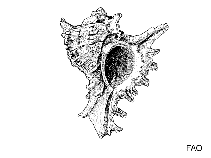
Gastropoda |
Neogastropoda |
Muricidae
Environnement : milieu / zone climatique / profondeur / gamme de distribution
Écologie
Benthic; profondeur 1 - 20 m (Réf. 83435). Tropical; 32°N - 18°S, 94°E - 32°E (Réf. 83435)
Western Atlantic.
Longueur à la première maturité / Taille / Poids / Âge
Maturité: Lm ? range ? - ? cm Max length : 2.2 cm DL mâle / non sexé; (Réf. 83435)
Found on hard substrate (Ref. 109264).
Cycle de vie et comportement reproducteur
Maturité | Reproduction | Frai | Œufs | Fécondité | Larves
This species is a non-broadcast spawner. Life cycle does not include trocophore stage. Also Ref. 833.
Miloslavich, P., J.M. Díaz, E. Klein, J.J. Alvarado, C. Díaz, J. Gobin, E. Escobar-Briones, Motta, J.J. Cruz, E. Weil, J. Cortés, A.C. Bastidas, R. Roberston, F. Zapata, A. Martín, J. Castillo, A. Kazandjian and M. Ortiz 2010 Marine biodiversity in the Caribbean: regional estimates and distribution patterns. PLoS ONE 5(8):e11916. (Réf. 86671)
Statut dans la liste rouge de l'IUCN
(Réf. 130435: Version 2025-2 (Global))
statut CITES (Réf. 108899)
Not Evaluated
Not Evaluated
Menace pour l'homme
Utilisations par l'homme
| FishSource |
Outils
Plus d'informations
Écologie trophiqueAliments (proies)
Composition du régime alimentaire
Consommation alimentaire
Prédateurs
Dynamique des populationsCroissance
Âges / tailles maximales
Longueur-poids rel.
Rel. longueur-longueur.
Fréquences de longueurs
Conversion de masse
Abondance
Cycle de vieReproductionMaturitéFéconditéFraiŒufsDéveloppement de l'œufLarves PhysiologieConsommation d'oxygène
Liées à l'hommeTimbres, pièces de monnaie, divers
Sources Internet
Estimations basées sur des modèles
Température préférée
(Ref.
115969): 26.3 - 28.3, mean 27.3 (based on 439 cells).
Vulnérabilité de la pêche
Low vulnerability (10 of 100).
Catégorie de prix
Unknown.