Bivalvia |
Mytilida |
Mytilidae
Environnement : milieu / zone climatique / profondeur / gamme de distribution
Écologie
Benthic; profondeur 0 - 15 m (Réf. 348). Tropical
Indo-Pacific: from East and South Africa, to Japan, Australia, New Caledonia and eastern Polynesia.
Longueur à la première maturité / Taille / Poids / Âge
Maturité: Lm ? range ? - ? cm Max length : 5.0 cm SHL mâle / non sexé; (Réf. 348); common length : 4.0 cm SHL mâle / non sexé; (Réf. 348)
Description synthétique
Morphologie
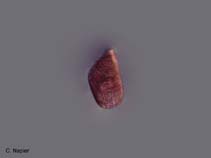
Shell thick, elongate, variable in shape, roughly trigonal-ovate or trapezoidal in outline, markedly swollen and pointed anteriorly, rounded and somewhat compressed posteriorly. Umbones terminal, prominent, sharply tapering and ventrally recurved. Anterior margin reduced. Ventral margin long and usually broadly concave. Posterodorsal area somewhat expanded and laterally compressed. Outer surface of valves covered with numerous, densely set radial riblets slightly diverging on posterodorsal and posteroventral areas. Periostracum strong, tightly applied to shell. Hinge with a few small denticles under the umbo of each valve. A strong shelly ledge above the umbonal cavity, supporting the anterior adductor scar and expanded dorsally as a low ridge along the ligament. Internal margins finely crenulated throughout. Colour: exterior of shell deep green, becoming brownish and paler towards the umbones. Interior bluish grey to purplish brown, white on the umbonal area.
Frequently found in areas exposed to washing of surf with strong water current (Ref. 80041). Attached to rocks, dead corals or the underside of stones, sometimes occurring in dense colonies. Littoral and sublittoral to a depth of about 15 m (Ref. 348). Living among the alga Corallina officinalis in rock-pools between tide-marks (Ref. 88739). Reported from Hong Kong to be found on the ceilings and walls of submarine caves (Ref. 126058).
Cycle de vie et comportement reproducteur
Maturité | Reproduction | Frai | Œufs | Fécondité | Larves
Members of the class Bivalvia are mostly gonochoric, some are protandric hermaphrodites. Life cycle: Embryos develop into free-swimming trocophore larvae, succeeded by the bivalve veliger, resembling a miniature clam.
Poutiers, J.M. 1998 Bivalves. Acephala, Lamellibranchia, Pelecypoda. p. 123-362. In Carpenter, K. E. and V. H. Niem. 1998. FAO species identification guide for fishery purposes. The living marine resources of the Western Central Pacific. Volume 1. Seaweeds, corals, bivalves, and gastropods. Rome, FAO. (Réf. 348)
Statut dans la liste rouge de l'IUCN
(Réf. 130435: Version 2025-2 (Global))
statut CITES (Réf. 108899)
Not Evaluated
Not Evaluated
Menace pour l'homme
Utilisations par l'homme
| FishSource |
Outils
Plus d'informations
Écologie trophiqueAliments (proies)
Composition du régime alimentaire
Consommation alimentaire
Prédateurs
Dynamique des populations Cycle de vieReproductionMaturitéFéconditéFraiŒufsDéveloppement de l'œufLarves PhysiologieConsommation d'oxygène
Liées à l'hommeTimbres, pièces de monnaie, divers
Sources Internet
Estimations basées sur des modèles
Température préférée
(Ref.
115969): 23.1 - 29.3, mean 28.3 (based on 3576 cells).
Résilience
Milieu, temps minimum de doublement de population : 1,4 à 4,4 années (K=0.23-0.34).
Vulnérabilité de la pêche
Low to moderate vulnerability (32 of 100).