Hexacorallia |
Scleractinia |
Agariciidae
Environnement : milieu / zone climatique / profondeur / gamme de distribution
Écologie
Récifal; profondeur 0 - 15 m (Réf. 87091). Tropical; 24°N - 8°N, 92°W - 58°W (Réf. 847)
Western Central Atlantic: Caribbean Sea.
Longueur à la première maturité / Taille / Poids / Âge
Maturité: Lm ? range ? - ? cm
Description synthétique
Morphologie
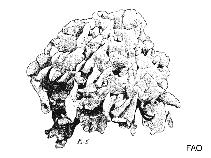
Colonies form a complex of thin upright bifacial fronds which have thin margins. They are usually contorted, elongate, and divide irregularly. Corallites are in valleys which is generally concentric and les than 50 millimeters long. Brown, greenish or rust in color, sometimes with pale margins of septo-costae and sometimes with orange tentacles.
Agaricia tenuifolia has been observed to a maximum depth of 15 m, based on personal communication with our expert, Charlie Veron. Zooxanthellate (Ref. 116012). Common along the Caribbean continental coast. Very common in Bocas del Torro, Panama; does not occur in Florida or the Bahamas (Ref. 415). This species exists almost exclusively in conspecific aggregations (Ref. 87225).
Cycle de vie et comportement reproducteur
Maturité | Reproduction | Frai | Œufs | Fécondité | Larves
Members of the class Anthozoa are either gonochoric or hermaphroditic. Mature gametes are shed into the coelenteron and spawned through the mouth. Life cycle: The zygote develops into a planktonic planula larva. Metamorphosis begins with early morphogenesis of tentacles, septa and pharynx before larval settlement on the aboral end.
Collin, R., M.C. Díaz, J. Norenburg, R.M. Rocha, J.A. Sánchez, M. Schulze, A. Schwartz and A. Valdés 2005 Photographic identification guide to some common marine invertebrates of Bocas Del Toro, Panama. Caribbean Journal of Science. 41(3):638-707. (Réf. 415)
Statut dans la liste rouge de l'IUCN
(Réf. 130435: Version 2025-2 (Global))
statut CITES (Réf. 108899)
Not Evaluated
Menace pour l'homme
Utilisations par l'homme
| FishSource |
Outils
Plus d'informations
Écologie trophiqueAliments (proies)Composition du régime alimentaireConsommation alimentairePrédateurs Dynamique des populationsCroissance
Âges / tailles maximales
Longueur-poids rel.
Rel. longueur-longueur.
Fréquences de longueurs
Conversion de masse
Abondance
Cycle de vieReproductionMaturitéFéconditéFraiŒufsDéveloppement de l'œufLarves PhysiologieConsommation d'oxygène
Liées à l'hommeTimbres, pièces de monnaie, divers
Sources Internet
Estimations basées sur des modèles
Température préférée
(Ref.
115969): 6.3 - 16.7, mean 10.3 (based on 90 cells).
Catégorie de prix
Unknown.