Scyphozoa |
Semaeostomeae |
Cyaneidae
Environnement : milieu / zone climatique / profondeur / gamme de distribution
Écologie
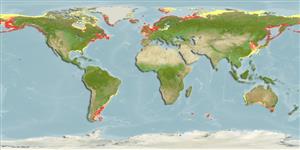
Pélagique; profondeur 0 - 85 m (Réf. 116114). Boreal; 81°N - 47°N, 34°W - 69°E
Arctic and Northeast Atlantic: from Iceland to France, north to Svalbard and east to Russia.
Longueur à la première maturité / Taille / Poids / Âge
Maturité: Lm ? range ? - ? cm Max length : 229 cm WD mâle / non sexé; (Réf. 99323)
Description synthétique
Morphologie
Diameter up to 100 cm; rhopalar and tentacular stomach pouches completely separated; peripheral canals more or less curved; without or with very few anastomoses; color reddish brown or yellowish.
The tentacle of the longest medusozoa meaures 36.6 m (Ref. 99323). The largest specimen observed was 2 meters wide (Ref. 121705). Estuarine, potentially pathogenic (Ref. 116114).
Cycle de vie et comportement reproducteur
Maturité | Reproduction | Frai | Œufs | Fécondité | Larves
Members of the class Scyphozoa are gonochoric. Life cycle: Egg is laid by the adult medusa which later develops into a free-living planula, then to a scyphistoma to a strobila, and lastly to a free-living young medusa.
Cairns, S.D., D.R. Calder, A. Brinckmann-Voss, C.B. Castro, D.G. Fautin, P.R. Pugh, C.E. Mills, W.C. Jaap, M.N. Arai, S.H.D. Haddock and D.M. Opresko 2003 Common and Scientific Names of Aquatic Invertebrates from the United States and Canada: Cnidaria and Ctenophore, Second Edition. American Fisheries Society Special Publication, no,28. XI+115. With CD-ROM. (Réf. 1663)
Statut dans la liste rouge de l'IUCN
(Réf. 130435: Version 2025-2 (Global))
statut CITES (Réf. 108899)
Not Evaluated
Not Evaluated
Menace pour l'homme
Utilisations par l'homme
| FishSource |
Outils
Plus d'informations
Dynamique des populations Cycle de vieReproductionMaturitéFéconditéFraiŒufsDéveloppement de l'œufLarves PhysiologieConsommation d'oxygène
Liées à l'hommeTimbres, pièces de monnaie, divers
Sources Internet
Estimations basées sur des modèles
Vulnérabilité de la pêche
Very high vulnerability (90 of 100).
Catégorie de prix
Unknown.