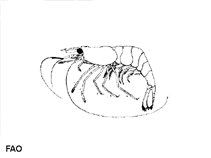
Malacostraca |
Decapoda |
Palaemonidae
Environnement : milieu / zone climatique / profondeur / gamme de distribution
Écologie
Benthic; saumâtre. Temperate; 60°N - 32°N, 11°W - 20°E
Northeast Atlantic and the Mediterranean: From north-west Europe and western Mediterranean and on the Atlantic coast of Morocco.
Longueur à la première maturité / Taille / Poids / Âge
Maturité: Lm ? range ? - ? cm Max length : 3.7 cm TL mâle / non sexé; (Réf. 2793); 5.2 cm TL (female)
Body almost colorless and translucent. Body of females sometimes with greenish chromatophores (Ref. 2793). Occurs in brackish water lakes and shallow coastal lagoons with salinity from 0.9 to 25.3 (Ref. 2745). Prefers stagnant and slow-running waters, irrigation channels and salt marshes (Ref. 2792). Associated with Palaemon elegans and/or Palaemon adspersus (Ref. 2745). Detritivores; with a varied diet characterized by scavenging and opportunistic feeding behavior (Ref. 2838).
Cycle de vie et comportement reproducteur
Maturité | Reproduction | Frai | Œufs | Fécondité | Larves
Exhibits moulting before breeding during spring at temperatures between 9 to 10°C (Ref. 2804). Females produce about 150 eggs (Ref. 2748).
Dolmen, D., J. Hindley and E. Kleiven 2004 Distribution of Palaemonetes varians (Leach) (Crustacea, Decapoda) in relation to biotope and other caridean shrimps in brackish waters of southern Norway and southwestern Sweden. Sarsia: North Atlantic Marine Science 89(1):8-21(14). (Réf. 2745)
Statut dans la liste rouge de l'IUCN
(Réf. 130435: Version 2025-2 (Global))
statut CITES (Réf. 108899)
Not Evaluated
Not Evaluated
Menace pour l'homme
Utilisations par l'homme
Pêcheries: commercial
FAO - Aquaculture: production; | FishSource | Sea Around Us
Outils
Plus d'informations
Dynamique des populationsCroissanceÂges / tailles maximalesLongueur-poids rel.Rel. longueur-longueur.Fréquences de longueursConversion de masseAbondance PhysiologieConsommation d'oxygène
Liées à l'hommeTimbres, pièces de monnaie, divers
Sources Internet
Estimations basées sur des modèles
Vulnérabilité de la pêche
Low vulnerability (10 of 100).
Nutrients : Calcium = 109 [35, 184] mg/100g; Iron = 1.59 [1.21, 1.97] mg/100g; Protein = 20.2 [19.2, 21.3] %; Omega3 = 0.285 [0.185, 0.386] g/100g; Selenium = 48.3 [-31.7, 128.3] μg/100g; VitaminA = 0 μg/100g; Zinc = 1.79 [1.17, 2.40] mg/100g (wet weight); based on
nutrient studies.