Gastropoda |
Not assigned |
Lottiidae
Environment: milieu / climate zone / depth range / distribution range
Ecology
Benthic. Polar
Northeast Pacific and Arctic: Alaska, Canada, USA, Mexico. Climate: polar to subtropical.
Length at first maturity / Size / Weight / Age
Maturity: Lm ? range ? - ? cm Max length : 2.0 cm NG male/unsexed; (Ref. 95344); common length : 2.0 cm SHL male/unsexed; (Ref. 312)
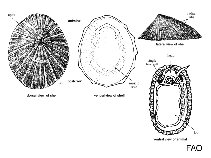
It is oval, chestnut brown, and smooth. Its shell never grows wider than the particular stipe it lives on (Ref. 312).
It has a shell length 2 cm long (Ref. 312). Habitat: On the blades of the Feather Boa kelp in the low intertidal zone; it is occasionally found on the Pterogyphora sp. Diet: Feather Boa kelp (Egregia spp. ) (Ref. 312).
Life cycle and mating behavior
Maturity | Reproduction | Spawning | Eggs | Fecundity | Larvae
Members of the order Patellogastropoda are mostly gonochoric and broadcast spawners. Life cycle: Embryos develop into planktonic trocophore larvae and later into juvenile veligers before becoming fully grown adults.
Gallivan, G. and J. Danforth 1999 Phylum Mollusca. Marine Science Institute. (Ref. 312)
IUCN Red List Status
(Ref. 130435: Version 2025-2 (Global))
CITES status (Ref. 108899)
Not Evaluated
Not Evaluated
Threat to humans
Human uses
| FishSource |
Tools
More information
Population dynamicsGrowth
Max. ages / sizes
Length-weight rel.
Length-length rel.
Length-frequencies
Mass conversion
Abundance
Life cycleReproductionMaturityFecunditySpawningEggsEgg developmentLarvae PhysiologyOxygen consumption
Human RelatedStamps, coins, misc.
Internet sources
Estimates based on models
Fishing Vulnerability
Low vulnerability (10 of 100).
Price category
Unknown.