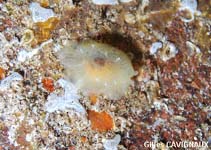
Gastropoda |
Pleurobranchida |
Pleurobranchidae
Environnement : milieu / zone climatique / profondeur / gamme de distribution
Écologie
Benthic; profondeur 0 - 7 m (Réf. 83435). Subtropical
Indo-Pacific, Western Atlantic and the Mediterranean Sea.
Longueur à la première maturité / Taille / Poids / Âge
Maturité: Lm ? range ? - ? cm Max length : 2.0 cm TL mâle / non sexé; (Réf. 844)
Assumed maximum length from Ref. 844. Found intertidally or in the shallow subtidal under rocks (Ref. 844).
Cycle de vie et comportement reproducteur
Maturité | Reproduction | Frai | Œufs | Fécondité | Larves
Members of the order Notaspidea are mostly simultaneous hermaphrodites.
Debelius, H. 2001 Nudibranchs and sea snails: Indo-Pacific field guide. Unterwasserarchiv, IKAN, frankfurt, Germany, 3rd ed. 321 pp. (Réf. 844)
Statut dans la liste rouge de l'IUCN
(Réf. 130435: Version 2025-2 (Global))
statut CITES (Réf. 108899)
Not Evaluated
Not Evaluated
Menace pour l'homme
Utilisations par l'homme
| FishSource |
Outils
Plus d'informations
Écologie trophiqueAliments (proies)
Composition du régime alimentaire
Consommation alimentaire
Prédateurs
Dynamique des populationsCroissance
Âges / tailles maximales
Longueur-poids rel.
Rel. longueur-longueur.
Fréquences de longueurs
Conversion de masse
Abondance
Cycle de vieReproductionMaturitéFéconditéFraiŒufsDéveloppement de l'œufLarves PhysiologieConsommation d'oxygène
Liées à l'hommeTimbres, pièces de monnaie, divers
Sources Internet
Estimations basées sur des modèles
Température préférée
(Ref.
115969): 15.7 - 29.2, mean 27.5 (based on 4551 cells).
Vulnérabilité de la pêche
Low vulnerability (10 of 100).
Catégorie de prix
Unknown.