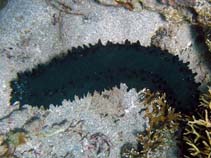
Holothuroidea |
Synallactida |
Stichopodidae
Ambiente: milieu / zona climatica / distribuzione batimetrica / gamma di distribuzione
Ecologia
Associati a barriera corallina; distribuzione batimetrica 0 - 15 m (Fonte Biblio. 122). Tropical; 36°N - 35°S, 29°E - 134°W
Indo-Pacific, excluding Persian Gulf and Hawaii. Tropical and subtropical.
Lunghezza alla prima maturità / Dimensione / Peso / Età
Maturità: Lm ? range ? - ? cm Max length : 40.0 cm TL maschio/sesso non determinato; (Fonte Biblio. 75656); common length : 18.0 cm TL maschio/sesso non determinato; (Fonte Biblio. 122); peso massimo pubblicato: 1.5 kg (Fonte Biblio. 75656)
Mean live weight: 100-400 g. Body-wall thickness 0.2 cm. Body firm, rigid with quadrangular section, flattened ventrally (trivium); body wall easily disintegrates outside sea water. Radii of bivium with characteristic double row of large papillae, each radius ending in a small red or orange papilla. Trivium delimited by characteristic double row of large papillae; stout podia arranged regularly on 3 radial bands, with 10 rows in the medio-ventral band and 5 in the lateral. Mouth ventral, surrounded by a row of papillae and 20 green, stout tentacles. Anus terminal. Calcareous ring with large radial pieces and narrow interradials. Cuvierian tubules absent. Cloaca large and greenish. Bivium dark green to black; trivium lighter. Spicules with very characteristic tables with a narrow disc showing 4 holes, bearing a spire generally ending in a moderately spiny crown; tables with larger disc and simpler crown also present; presence of many C-shaped spicules; rosettes absent; tables in dorsal with have a large multiperforated disc, bearing a large spire; ventral papillae with long, smooth rods; ventral podia with denticulate rods and large multiperforated plates; tentacles with smooth and granular rods.
Probably harvested in some artisanal fisheries of the area. Collected by hand at low tide, or by divers. The processed product is of low commercial value. A reef species mostly found in shallow areas from near the surface to a depth of 15 m (Ref. 122). Found on sandy areas (Ref. 115900) and generally occurs on reef flats and upper slopes. Populations reaching high densities on hard substrates, with a mean of around 0.04 per square meter. Shallow water populations are generally smaller in size than those found in deeper waters. Biology poorly known (Ref. 122).
Ciclo vitale e comportamento di accoppiamento
Maturità | Riproduzione | Deposizione | Uova | Fecondità | Larve
Members of the class Holothuroidea are gonochoric and have only one gonad. Spawning and fertilization are both external and some exhibit brooding. Life cycle: Embryos develop into planktotrophic larvae (auricularia) then into doliolaria (barrel-shaped stage) which later metamorphose into juvenile sea cucumbers.
Conand, C. 1998 Holothurians (sea cucumbers, Class Holothuroidea). p. 1157-1190. In Carpenter, K.E. and V.H. Niem (eds.) FAO Species Identification Guide for Fishery Purposes. The Living Marine Resources of the Western Central Pacific. Vol. 2. Cephalopods, crustaceans, holothurians and sharks. FAO Rome. (Fonte Biblio. 122)
Stato della Lista Rossa IUCN
(Fonte Biblio. 130435: Version 2025-2 (Global))
Stato della CITES (Fonte Biblio. 108899)
Not Evaluated
CMS (Fonte Biblio. 116361)
Not Evaluated
Minaccia per l'uomo
Harmless
Usi umani
Pesca: scarso interesse commerciale
| FishSource |
Strumenti
Informazioni ulteriori
Ecologia troficaArticoli alimentari (prede)
Alimentazione
Consumo di cibo
Predatori
Dinamica della popolazione Ciclo di vitaRiproduzioneMaturitàFeconditàDeposizioneUovaSviluppo delle uovaLarve FisiologiaConsumo di ossigeno
Legato all'uomoFrancobolli, monete, materiale vario.
Fonti Internet
Stime basate su modelli
Temperatura preferita
(Ref.
115969): 24.7 - 29.3, mean 28.4 (based on 3352 cells).
Resilienza
Alto, tempo minimo di raddoppiamento della popolazione meno di 15 mesi (K=0.45).
Vulnerabilità della pesca
Moderate vulnerability (36 of 100).
Categoria di prezzo
Unknown.