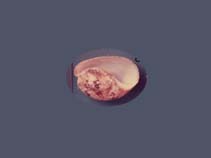
Gastropoda |
Cephalaspidea |
Bullidae
Milieu: milieu / Klimaatzone / Diepte / verspreidingsgebied
Ecologie
Benthic; diepte 0 - 165 m (Ref. 107300). Tropical
Indo-Pacific, Southeast Atlantic and the Mediterranean.
Lengte bij maturiteit / Grootte / Gewicht / Leeftijd
Maturiteit: Lm ? range ? - ? cm Max length : 5.0 cm TL mannelijk / geslacht onbekend; (Ref. 844)
Assumed maximum length from Ref. 844. A strictly herbivorous species that is common on rocky reefs (Ref. 844), and always found around soft silt or mud in where it is usually buried (Ref. 866) during the day (Ref. 107294); common in deep rock pools and tidal swimming pools (Ref. 866). Nocturnal. Emerges at night to feed on seaweeds and grasses (Ref. 107294).
Levenscyclus en paargedrag
Maturiteit | Voortplanting | Paaien | Eieren | Fecunditeit | Larven
Members of the order Cephalaspidea are mostly simultaneous hermaphrodites.
Debelius, H. 2001 Nudibranchs and sea snails: Indo-Pacific field guide. Unterwasserarchiv, IKAN, frankfurt, Germany, 3rd ed. 321 pp. (Ref. 844)
Status op de Rode Lijst van het IUCN
(Ref. 130435: Version 2025-2 (Global))
CITES status (Ref. 108899)
Not Evaluated
Not Evaluated
Gevaar voor de mens
Gebruik door de mens
| FishSource |
Tools
Meer informatie
LevenscyclusVoortplantingMaturiteitFecunditeitPaaienEierenOntwikkeling van de eierenLarven FysiologieZuurstofverbruik
Menselijk gerelateerdPostzegels, munten, diversen.
Internetbronnen
Schattingen op basis van modellen
Gewenste temperatuur
(Ref.
115969): 23.7 - 29, mean 27.5 (based on 986 cells).
Kwetsbaarheid van de visserij
Low vulnerability (10 of 100).
Prijsklasse
Unknown.