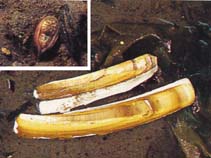
Bivalvia |
Adapedonta |
Pharidae
Environment: milieu / climate zone / depth range / distribution range
Ecology
Benthic; brackish; depth range 0 - 73 m (Ref. 104365). Temperate, preferred 12°C (Ref. 107945); 60°N - 18°N, 91°W - 52°W
Western Atlantic: from Newfoundland and Labrador, Canada to Florida and southern Gulf of Mexico to Campeche, Mexico. Introduced in the Northeast Atlantic from UK (England and Wales), the North Sea to southern Norway and southern Baltic Sea to Spain in the southern Bay of Biscay. Tropical to temperate.
Length at first maturity / Size / Weight / Age
Maturity: Lm ? range ? - ? cm Max length : 26.0 cm TL male/unsexed; (Ref. 7726)
Comprise communities and assemblages throughout the Mid-Atlantic Bight (Ref. 80354). Inhabits littoral and sublittoral sediment (Ref. 1314). Found in areas influenced by estuarine outflows (Ref. 96507). Swims backward (Ref. 80328).
Life cycle and mating behavior
Maturity | Reproduction | Spawning | Eggs | Fecundity | Larvae
Members of the class Bivalvia are mostly gonochoric, some are protandric hermaphrodites. Life cycle: Embryos develop into free-swimming trocophore larvae, succeeded by the bivalve veliger, resembling a miniature clam.
Turgeon, D.D., W.G. Lyons, P. Mikkelsen, G. Rosenberg and F. Moretzsohn 2009 Bivalvia (Mollusca) of the Gulf of Mexico. pp. 711-744 In Felder, D.L.; Camp, D.K. (eds.) Gulf of Mexico - Origins, Waters, and Biota. Biodiversity. Texas A&M University Press, College Station, Texas. (Ref. 104365)
IUCN Red List Status
(Ref. 130435: Version 2025-2 (Global))
CITES status (Ref. 108899)
Not Evaluated
Not Evaluated
Threat to humans
Human uses
Fisheries: commercial
FAO - Fisheries: landings | FishSource | Sea Around Us
Tools
More information
Life cycleReproductionMaturityFecunditySpawningEggsEgg developmentLarvae PhysiologyOxygen consumption
Human RelatedStamps, coins, misc.
Internet sources
Estimates based on models
Preferred temperature
(Ref.
115969): 4.1 - 26, mean 9.7 (based on 362 cells).
Fishing Vulnerability
Low vulnerability (16 of 100).
Climate Vulnerability
Very high vulnerability (76 of 100).
Nutrients : Calcium = 149 [71, 228] mg/100g; Iron = 8.53 [1.95, 15.11] mg/100g; Protein = 9.88 [8.64, 11.12] %; Omega3 = 0.313 [0.202, 0.423] g/100g; Selenium = 61 [50, 72] μg/100g; VitaminA = 0 μg/100g; Zinc = 2.04 [0.56, 3.51] mg/100g (wet weight); based on
nutrient studies.