Octocorallia |
Scleralcyonacea |
Pennatulidae
Environment: milieu / climate zone / depth range / distribution range
Ecology
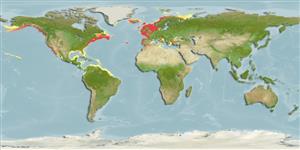
Sessile; depth range 11 - 1200 m (Ref. 138197). Subtropical; 60°N - 18°N, 125°W - 37°E
Eastern Pacific, Atlantic Ocean, and the Mediterranean: from California to Gulf of Mexico, north to Skagerrak and east to Turkey, Levantine Sea.
Length at first maturity / Size / Weight / Age
Maturity: Lm ? range ? - ? cm Max length : 9.9 cm TL male/unsexed; (Ref. 83653)
Minimum depth based from Ref. 138260. Epibenthic (Ref. 87524). Attached species (Ref. 3123). Known from circalittoral and bathyal zones (Ref. 85338).
Life cycle and mating behavior
Maturity | Reproduction | Spawning | Eggs | Fecundity | Larvae
Members of the class Anthozoa are either gonochoric or hermaphroditic. Mature gametes are shed into the coelenteron and spawned through the mouth. Life cycle: The zygote develops into a planktonic planula larva. Metamorphosis begins with early morphogenesis of tentacles, septa and pharynx before larval settlement on the aboral end.
Cairns, S.D., D.R. Calder, A. Brinckmann-Voss, C.B. Castro, D.G. Fautin, P.R. Pugh, C.E. Mills, W.C. Jaap, M.N. Arai, S.H.D. Haddock and D.M. Opresko 2003 Common and Scientific Names of Aquatic Invertebrates from the United States and Canada: Cnidaria and Ctenophore, Second Edition. American Fisheries Society Special Publication, no,28. XI+115. With CD-ROM. (Ref. 1663)
IUCN Red List Status
(Ref. 130435: Version 2025-2 (Global))
CITES status (Ref. 108899)
Not Evaluated
Not Evaluated
Threat to humans
Human uses
| FishSource |
Tools
More information
Trophic EcologyFood items (preys)
Diet composition
Food consumption
Predators
Population dynamicsGrowthMax. ages / sizesLength-weight rel.Length-length rel.Length-frequenciesMass conversionAbundance Life cycleReproductionMaturityFecunditySpawningEggsEgg developmentLarvae PhysiologyOxygen consumption
Human RelatedStamps, coins, misc.
Internet sources
Estimates based on models
Preferred temperature
(Ref.
115969): 6.3 - 12.4, mean 9.2 (based on 503 cells).
Fishing Vulnerability
Low vulnerability (10 of 100).
Price category
Unknown.