| 描述 |
The semi-enclosed Baltic Sea (370,000 km2; 21,000 km3), 54° to 66° N, is one of the largest brackish water bodies in the world. It is very shallow with a mean depth of 57 m, and about 17% of the area is shallower than 10 m (Kullenberg, 1983). The Baltic Sea depression essentially constitutes a long fjord in the N-S direction (1,500 km) with an average width of 230 km. The topography divides the sea into a series of relatively deep basins, with maximum depths of 105 – 459 m. It is connected to the Atlantic via the Skagerrak and a narrow and shallow transition. For these reasons, a lateral exchange of deep and bottom water can only occur by water from the North Sea, a distance of about 1,000 km, and must pass over several shallow sills. Large scale meteorological conditions determine long-term fluctuations of salinity and temperature in the deep and bottom waters. The Baltic Sea has a marked positive fresh water balance, with an annual river runoff of 440-480 km³, or about 2.2% of the volume (Ehlin, 1981). The runoff usually has a maximum in May and a minimum in January or February, with large long-term variations. A marked permanent salinity stratification results in a transition layer at 65 to 75 m. The Baltic Sea has several important natural characteristics: large positive water balance, brackish water with large and stable horizontal and vertical salinity gradients, strong physical constraints on water exchange and mixing, imposing large residence time (several decades), special geochemical systems through oscillations between oxic and anoxic conditions in bottom and deep waters (http://www.na.nmfs.gov/lme/text/lme23.htm)
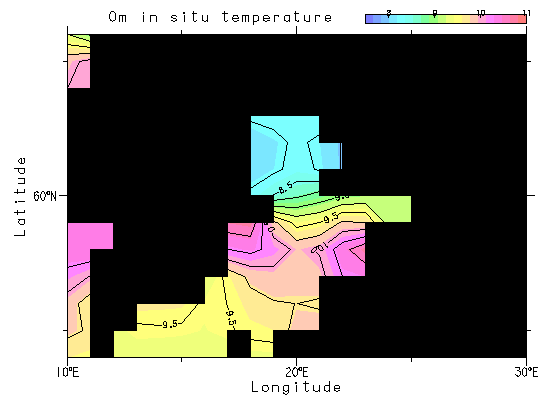
Temperature given for 100m depth is for 50m depth. Shelf sea; little tidal influence; salinity of surface water decreasing from 10 ppt in the West to 3 ppt in the East; deep, salty water originates from occasional storm-induced inflows from the Northsea through the Kattegatt. The oxygen content and thus the benthic life below the halocline completly depends on these inflows since there is little exchange with surface waters. |